
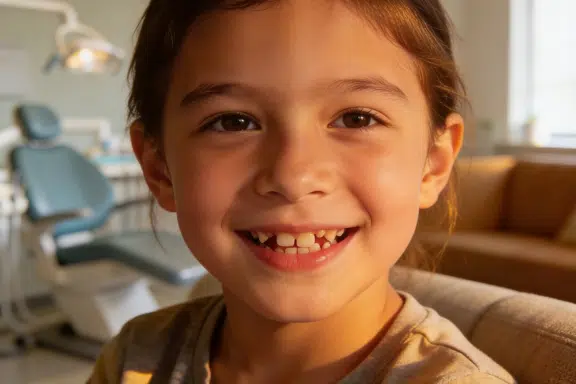
Usually, yes — at least during the years when baby teeth are falling out and adult teeth are coming in. But “normal” has limits, and knowing where those limits are is what Dr. Jen does every day at Impact Orthodontics.
One of the most common things parents say when they call the office is some version of: “My child’s teeth look crooked — is that okay?” The answer is almost always: it depends on the age, which teeth, and what the crookedness is telling us about the jaw.
The in-between years: ages 6 to 12
Between about ages 6 and 12, kids have a mix of baby teeth and adult teeth coming in — often at different times and speeds. During these years, some crowding or teeth that don’t quite line up is totally normal.
Adult teeth are a lot bigger than the baby teeth they’re replacing. Your child’s jaw is still growing to make room for them. In the short term, things can look pretty chaotic. That doesn’t mean something is wrong.
What Dr. Jen looks for at this stage isn’t whether teeth are perfectly straight — they won’t be yet. She’s checking whether the jaw is growing like it should, whether the bite is coming together the right way, and whether anything looks like it could become a bigger problem down the road.
What actually causes crooked teeth in children
Most crooked teeth come down to a size mismatch — the jaw is too small for the teeth, or the teeth are too big for the jaw. This tends to run in families. If you or your partner had braces or other orthodontic treatment, there’s a reasonable chance your child will too. But that’s not the whole story. Other common causes include:
Baby teeth lost too early. When a baby tooth falls out or gets pulled before it’s ready — from a cavity, an injury, or a dentist — the teeth on either side can slide into the empty space before the adult tooth is ready to grow in. That shifting causes crowding that wouldn’t have happened otherwise.
Habits that go on too long. Thumb sucking, pacifier use, or pushing the tongue against the teeth past age 3 or 4 puts steady pressure on the teeth and jaw. Over time, that pressure can shift things around and change how the jaw grows. The sooner the habit stops, the better the chance that any small changes will fix themselves.
Mouth breathing. Kids who breathe mostly through their mouth — often because of allergies, swollen adenoids (glands in the back of the throat), or a blocked airway — tend to grow a narrower upper jaw. A narrower jaw means less space for adult teeth to grow in, and that shows up as crowding. Dr. Jen checks for breathing issues at every appointment because the jaw and the airway are more connected than most parents realize.
Dr. Jen also sees a lot of teenagers lately with crowding caused by baby teeth that just won’t fall out on their own — these are called over-retained baby teeth. When a baby tooth hangs on too long, the adult tooth underneath has nowhere to go and can end up growing in at completely the wrong spot.
When crooked teeth are a bigger problem
Some crookedness isn’t just about crowded teeth — it’s about what’s going on with the jaw itself. A few things Dr. Jen takes more seriously:
Crossbite. This is when one or more upper teeth land inside the lower teeth instead of outside them. Over time, the jaw can shift to one side and change how the face grows. Crossbites are one of the clearest cases where acting early — often with a palate expander — makes a lasting difference that’s much harder to get later.
Underbite. This is when the lower jaw sticks out in front of the upper jaw. In kids, this can often be fixed with special jaw appliances. In adults, the same problem usually needs surgery. The window to treat it without surgery closes as the jaw stops growing in the mid-teens.
Narrow palate. A narrow upper jaw doesn’t always look like crooked teeth at first, but it often leads to crowding as the adult teeth grow in. It’s also closely linked to mouth breathing and less room to breathe through the nose. If this sounds like your child, a growth assessment can give you a full picture of what’s going on and what, if anything, to do about it.
Serious crowding. When teeth are really stacking on top of each other — not just slightly off — that usually won’t sort itself out on its own. Does my child need Phase 1 orthodontic treatment? explains when treating early makes a real difference and when it’s fine to wait.
It’s worth knowing that even teeth that look “only slightly crooked” aren’t always harmless. A single tooth that’s twisted or a bite that’s a little off can cause uneven wear on the teeth, make some spots harder to brush (which raises the risk of cavities), and can put extra stress on the jaw joints over time. Mildly crooked doesn’t automatically mean “leave it.”
What parents notice first — and what it usually means

Crooked bottom front teeth are usually the first thing parents notice. The lower front teeth come in early and often crowd together before the jaw has had a chance to grow and make room for them. Mild crowding in a 6 or 7 year old is very common and often gets better on its own as the jaw grows. By age 10 or 11, if there’s still significant crowding, it’s worth getting checked out.
A crooked front tooth coming in behind a baby tooth that hasn’t fallen out — the “shark teeth” look — usually sorts itself out once the baby tooth is removed or falls out on its own. If the adult tooth appears to be growing in completely the wrong direction, that’s worth getting looked at sooner rather than later.
Slightly crooked baby teeth are usually not a big deal on their own. What matters is whether the spacing suggests the adult teeth will have enough room to come in. A baby tooth that looks perfectly placed can still signal a developing crowding problem — and vice versa.
Treatment options when something needs fixing
Not every child with crooked teeth needs treatment right away — and Dr. Jen is straightforward about that. When something does need to be addressed, the approach depends on what the problem is and how old your child is:
Braces are still the most effective option for complex or more serious crowding. In some cases they can be started as young as age seven — when waiting would make things harder to fix, or would mean more involved treatment later. The Canadian Association of Orthodontists estimates more than 400,000 Canadians are currently in orthodontic treatment.
Clear aligners work well for moderate cases in older children and teens who will wear them consistently (22 hours per day). They’re not the right fit for every case, and Dr. Jen will tell you directly if braces are the better choice.
Palate expanders are often the right first step when a narrow jaw is causing crowding or contributing to breathing problems. Does my child need a palate expander? covers how expanders work, what to expect, and when they’re recommended.
In many cases, the recommendation is simply watch and wait. Dr. Jen only recommends treatment when it will actually make a real difference. When she does, she explains exactly what the problem is, why timing matters, and what happens if you decide to wait — so you can make a real, informed decision rather than just going along with what you’re told.
The age 7 check-up — why it matters
The Canadian Association of Orthodontists recommends that every child get an orthodontic check-up by age 7. That’s not because most 7-year-olds need treatment — most don’t. It’s because by age 7, there are enough adult teeth in place to see how the bite is coming together, and any problems worth catching early can be spotted while the jaw is still growing and easier to work with.
In Dr. Jen’s experience, the families who benefit most from early screening are the ones who would never have guessed anything was developing — because the problems that matter most at age 7 aren’t always visible in the bathroom mirror. The children’s orthodontics page has more on what that first visit involves and what we’re actually looking for.
Find out where your child stands
If your child’s teeth look crooked and you’re wondering whether it’s time to do something — the answer isn’t in the mirror. A short assessment gives you the information you actually need.
If everything is developing normally, you’ll leave relieved. If something is worth addressing, you’ll have found out at the best possible time. For children under 20, consultations at Impact Orthodontics are always free.
Book a free assessment at Impact Orthodontics — SE or SW Calgary location.
Frequently asked questions
At what age should I start worrying about my child’s crooked teeth?
Mild crookedness between ages 6 and 12 is usually normal — adult teeth are bigger than baby teeth, and the jaw needs time to catch up. By age 7, though, there are enough adult teeth in place that an orthodontist can spot anything worth watching. First assessments at Impact Orthodontics are always free for children under 20.
Will my child’s crooked teeth straighten out on their own?
Some mild crowding does improve as the jaw grows. But crossbites, underbites, and serious crowding won’t fix themselves — and some get harder to treat the longer they go. How do I know if my child needs braces? helps you figure out which category your child falls into.
What’s the difference between normal crooked teeth and a problem that needs treatment?
Normal crookedness is temporary — it’s part of the messy transition from baby teeth to adult teeth. A problem worth treating is one where the jaw is too narrow, the bite isn’t coming together right, or teeth are stuck or growing the wrong way. Does my child need Phase 1 orthodontic treatment? explains the difference between findings that need early care and ones that can wait.
Can a palate expander fix crooked teeth?
If the crookedness is caused by a jaw that’s too narrow — which is often the case — widening the jaw with an expander can create enough room for teeth to come in straighter. Does my child need a palate expander? covers how that works and when it’s the right call.
Do slightly crooked teeth always need treatment?
Not always. But slightly crooked doesn’t automatically mean harmless — a single twisted tooth or a bite that’s a little off can cause uneven wear and make spots harder to brush. The only way to know if it’s worth treating is an assessment. First consultations at Impact Orthodontics are always free for children under 20.


